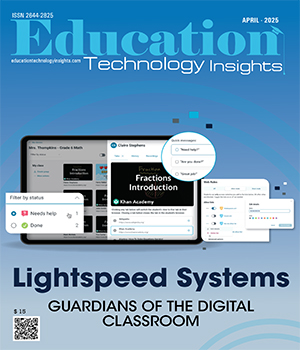

Lightspeed Systems: Guardians Of The Digital Classroom

K-12 District Security and Safety of the Year - 2025

The world is witnessing a technological renaissance in education and safety, transforming classrooms and campuses. Today’s groundbreaking STEM solutions providers are reimagining learning environments with virtual laboratories and simulation-based platforms, enabling students to conduct experiments and engage with complex scientific concepts without the constraints of traditional classroom settings. Augmented reality (AR) and virtual reality (VR) tools are now commonplace, offering immersive experiences that bring abstract theories to life.

Parallel to the advancements in STEM, K-12 district security is undergoing a technological transformation to create safer educational environments. Recent developments have focused on integrating real-time analytics with IoT-enabled security systems. Modern surveillance cameras now incorporate AI to detect unusual behavior and identify potential threats before they escalate. Additionally, biometric systems and advanced access control measures are being deployed to ensure authorized personnel can access school premises.

Driven by these trends, STEM education in the K-12 market is projected to reach $177.5 billion by the end of 2033, growing at a CAGR of 13.6 percent from 2025 to 2033.

This edition of the Education Technology Insights offers a detailed look into the latest innovations and how companies align with these trends.

The magazine features a thought-provoking article from Alex Sarlin, Senior Advisor, Product at Cambiar Education. In it, he advocates for a transformation in STEM education, where AI-driven, project-based and purpose-driven learning replace outdated models to create a more inclusive and future-ready education system. Another article by Sean Beaverson, Director of Technology at Orono Public Schools and Andrew Rummel, Digital Learning Coordinator for Bloomington Public Schools, emphasizes that AI and digital tools should enhance, not replace, the collaborative and human-centered aspects of STEM education.

We also bring you top STEM Solutions Providers who offer cutting-edge products and solutions. A noteworthy story is that of Lightspeed Systems. This well-established company provides cloud-managed solutions for K-12 schools, ensuring safety, compliance and engagement across devices.

In this edition featuring the Top STEM Solutions Providers 2025, K-12 District Security and Safety of the Year 2025, we hope you find the right partner to meet your organization’s needs.
    K-12 District Security and Safety of the Year

  • Lightspeed Systems provides cloud-managed solutions for K-12 schools, ensuring safety, compliance, and engagement across devices. With 25 years of expertise, Lightspeed serves over 23 million students globally, empowering districts to create secure, effective learning environments with innovative, time-saving tools.

    www.lightspeedsystems.com

K12 Solutions FAQ

Q1
What Do Top K12 Solutions Providers Do for Schools and Districts?
Top K12 Solutions Providers support schools, districts and education institutions with tools and services that improve teaching, learning, administration and student engagement. Their work may include digital learning platforms, curriculum technology, assessment systems, classroom management tools, communication software, data solutions and student support services. Strong providers understand the realities of K-12 education, including teacher workload, diverse learner needs, compliance expectations and budget constraints. The best K12 solutions providers help schools modernize without losing focus on instructional quality, accessibility and measurable student outcomes.
Q2
Why Are K12 Solutions Important for Modern Education?
K12 solutions poviders matter because schools are balancing academic recovery, digital adoption, personalized learning and increasing expectations from families and communities. Technology is no longer limited to remote learning; it now supports daily instruction, assessment, attendance, safety, communication and intervention planning. Districts need solutions that work across classrooms, grade levels and student populations. Well-designed K12 education technology can help educators identify learning gaps, improve engagement and make school operations more responsive while keeping the student experience at the center.
Q3
How Are Leading K12 Solutions Providers Typically Evaluated?
A Top list for K12 solutions providers should consider more than product breadth or brand visibility. Editorial evaluation often looks at relevance to school needs, ease of implementation, educator usability, data privacy, integration with existing systems and evidence of meaningful outcomes. Strong providers also offer training, responsive support and solutions that can scale across campuses or districts. Since K-12 environments are complex, selection should favor providers that combine education expertise with practical technology rather than relying only on features, dashboards or broad claims.
Q4
What Value Do K12 Solutions Create for Schools and Students?
Effective K12 solutions can improve how schools organize instruction, support teachers and respond to student needs. Benefits may include faster assessment feedback, better communication with families, more consistent curriculum delivery and clearer visibility into performance trends. Top K12 Solutions Providers also help administrators reduce fragmented tools and improve decision-making across departments. For students, the value is strongest when technology supports engagement, accessibility and timely academic support instead of adding complexity. Good solutions should make learning environments more connected, inclusive and easier to manage.
Q5
How Does Innovation Shape K12 Education Technology?
Innovation in K12 solutions is increasingly focused on personalization, interoperability, accessibility and responsible use of data. AI, automation and analytics may help educators spot patterns, recommend interventions or reduce repetitive administrative tasks, but strong solutions still keep teachers in control. Digital learning platforms must also be secure, age-appropriate and adaptable to different school settings. The most credible providers treat innovation as a way to strengthen instruction and school operations, not as a substitute for educator judgment, relationship-building or sound curriculum design.
Q6
What Should School Leaders Prioritize When Comparing K12 Solution Providers?
School leaders should compare K12 solution providers by focusing on instructional fit, implementation support, privacy safeguards, accessibility, long-term cost and educator adoption. A solution should align with district goals, integrate with existing systems and remain useful beyond a single initiative or funding cycle. Top K12 Solutions Providers are typically those that understand classroom realities, support professional learning and show how their tools improve outcomes in practical ways. Decision-makers should also consider whether a provider can serve teachers, students, administrators and families with clarity and consistency.